

‘Tables of Egypt’ Brings a Landmark Egypt Book to Life at GEM
At Cairo Food Week, Suzanne Zeidy and Rawah Badrawi’s 420-page portrait of Egyptian food expands into a museum exhibition.
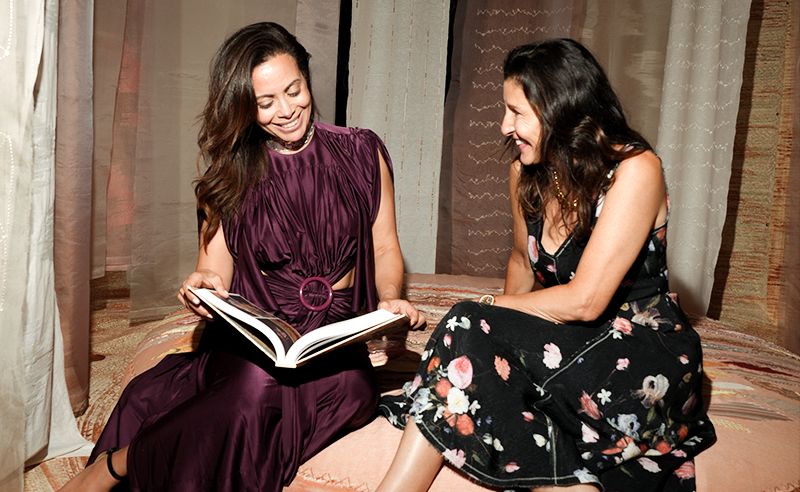
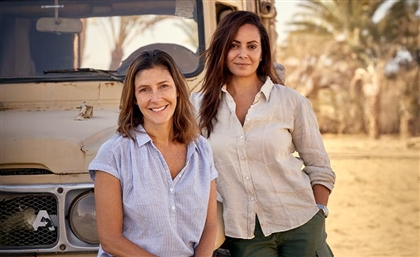
For years, writers, anthropologists and archivists Suzanne Zeidy and Rawah Badrawi had to argue that Egyptian food could fill a book. At Cairo Food Week, their book filled a museum.
On September 25th, Egypt: Recipes and Stories from an Ancient Land expanded beyond its 420 pages to become 'Tables of Egypt,' an immersive pop-up exhibition at the Grand Egyptian Museum. Created as a WHEN WE EAT concept for the fourth edition of Cairo Food Week, ‘Tables of Egypt’ is powered by MARAKEZ and hosted under the Auspices of Egyptian Tourism Authority. Its premise was both ambitious and strangely intimate: to take the country Zeidy and Badrawi had spent years documenting and allow its landscapes, people and food rituals to assume physical form.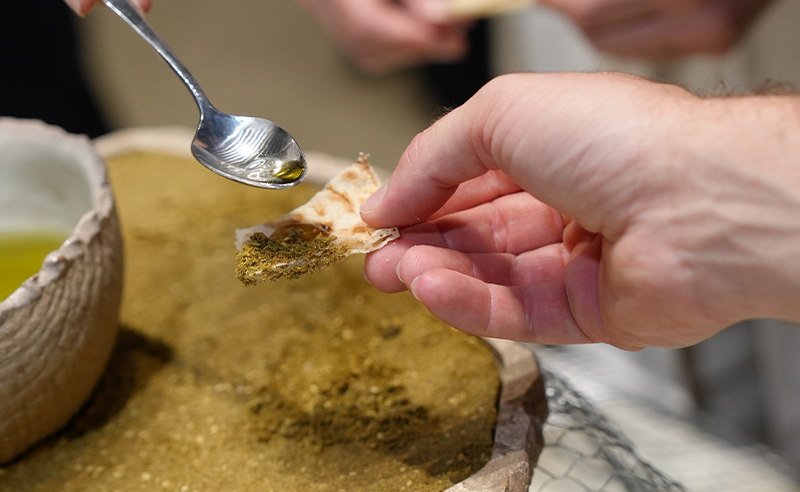 The occasion carried a certain vindication. International publishers had repeatedly told the co-authors that Egypt was not known for its food. Neither woman was a celebrity chef or fixture of food television, and the industry saw no established market waiting for a comprehensive Egyptian cookbook. Their eventual rebuttal contained more than 150 recipes gathered across 14 cities and towns. It exceeded its commission by 120 pages, even after histories, photographs and recipes were removed. Badrawi estimates that another 200 recipes remained outside the binding.
At ‘Tables of Egypt’, even the book proved too small for its subject.
Zeidy and Badrawi had travelled across the country with photographer Jonathan Gregson, entering kitchens in which recipes existed as movement, memory and inherited instinct rather than written instruction. Zeidy filmed cooks at work, returned home and tested their dishes repeatedly until quantities another person could follow emerged from the gestures. Yet the authors resisted presenting any one version as definitive. “We’re saying this is her recipe,” Zeidy explained. “It’s not the recipe.”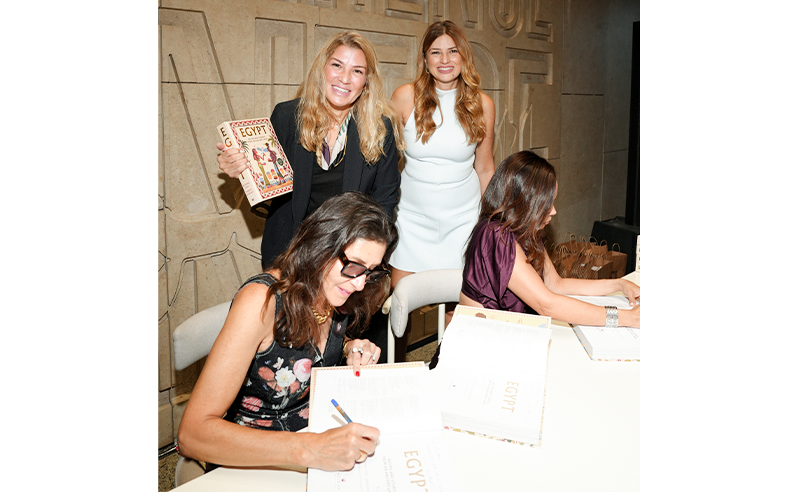 That distinction became the book’s ethical centre. A dish was never detached from the person who made it, the land that supplied it or the history through which it had travelled. “The dish is nothing without context,” Zeidy said. “Who are the people? What is the land like?”
‘Tables of Egypt’ gave those questions an architectural answer. Creatively developed by Hana Shash and realised by lead exhibition designer Ramzi Makram-Ebeid, the exhibition arranged the country into five circular capsules: the Sea, Desert, River, Mountain and Cairo. The route traced the landscapes that shape Egypt’s ingredients, techniques and rituals before following them towards the capital, where they continually meet, settle and change.
“When I first looked through Egypt: Recipes and Stories from an Ancient Land, I discovered a side of Egyptian cuisine that genuinely surprised me,” said Makram-Ebeid. “We wanted to create an exhibit which showcased how everything affects our cuisine, and do something that was different, that people haven’t seen.”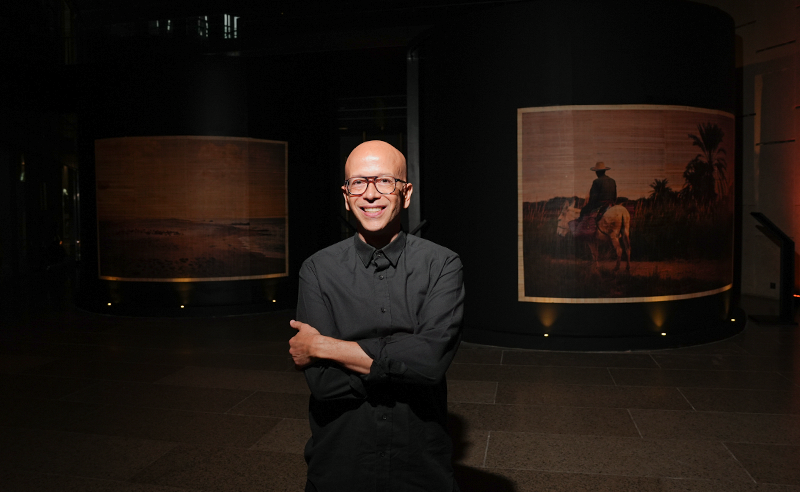 Makram-Ebeid paired the circular structures with a sunset palette, while Gregson’s photographs were printed on impressively large spreads of papyrus. Visitors entered each capsule through sweeping images of the landscape and departed through portraits of the people who inhabit it. The shift in scale quietly restated the book’s argument: geography begins the story of food, but people are the reason it survives.
Each landscape was entrusted to an artist rather than reconstructed literally. At the Sea, award-winning Alexandrian visual storyteller Mohamed Mahdy, supported by Mai Eldib, presented ‘Next Time, Ask the Sea’, treating the coast as an archive of movement and belonging held within the memories of its communities. The film was edited by Cindy Ouda, with colour grading by LZRD and sound mixing by UFO Studios.
The Desert followed, shaped by water, season and scarcity into a culture of preservation, resourcefulness and emphatic hospitality. Architect and urbanist Shahira Fahmy responded with ‘Palm Grove’, reading the palm as an enduring emblem of shelter, sustenance and belonging. The installation featured the work of artisan Khoos Egypt.Along the River, interior designer and creative consultant Emma James presented ‘The Nile Winks’, approaching the Nile as a living presence carrying fertility, nourishment, movement and memory. Its material world brought together Khoos Egypt, Third Space, Alef Gallery, Heba Linens, Ashgan Makarem and Threads of Hope.
The route then climbed into the Mountain, where South Sinai’s Bedouin and monastic traditions connect food with faith, season, and close attention to the land. French multidisciplinary artist and designer Louis Barthélemy interpreted the mountain as a threshold between earth and the divine in Floating Mountain, a meditation on faith, fragility and transcendence. Khattab, the installation’s Creative Print and Material Partner, developed its textures and layered material language with Barthélemy. Jimmy Gami translated that direction into physical form through prototyping, fabrication and execution.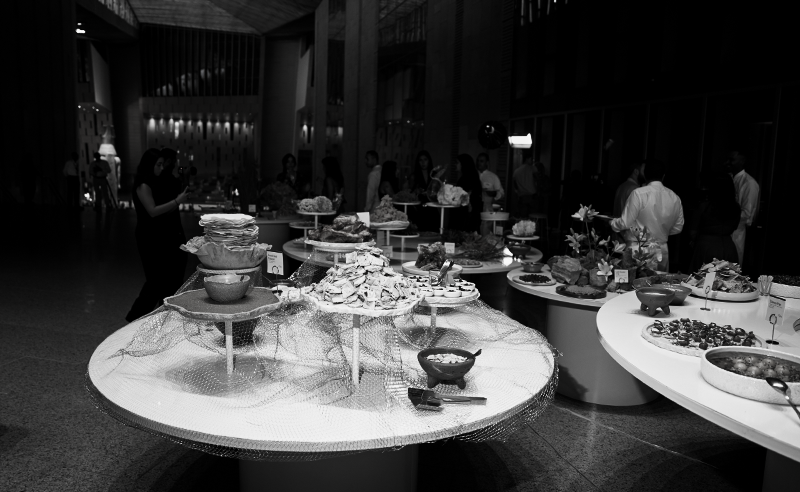 The landscape held particular significance within the book. In St Catherine’s, Zeidy and Badrawi had encountered a Bedouin mountain diet sustained by ancient gardens and an intimate knowledge of herbs, nuts, seeds, fruit, dates and goat products. One woman gave them a box of dried rose petals, which Zeidy carried to Berlin and then London to be photographed for a recipe. Whenever the box opened, the mountain’s scent escaped.
Yet bringing food down from the gardens had become increasingly difficult, while supermarkets and co-operatives made pasta and bottled tomato sauce readily available. A recipe might preserve the instructions, the authors discovered, even as the ecological and social world that once made it ordinary began to disappear.
The exhibition culminated in Cairo, where the preceding landscapes - and the people moving between them - leave their traces upon the table. Badrawi came to understand the capital not as the inventor of a single cuisine but as “a receiver of a cuisine”: a city whose food records generations of migration, marriage, trade, class aspiration and exile. Some of the heirloom recipes gathered for the chapter had been guarded by Cairene families for centuries. When one relative protested that a great-aunt had surrendered a family secret, Badrawi replied, with considerable finality, “Well, too late.”
Shahira Fahmy returned in the Cairo capsule with ‘Baladi Bread’, examining one of the city’s most familiar foods as an expression of daily ritual, cultural memory and Cairo’s ongoing negotiation between inheritance and change. The installation featured artisan Ashgan Makarem.
These works did not decorate the book or reproduce it page by page. They interpreted the ecosystem of knowledge contained within it: who cooks a dish, on what land, with which crop, after what migration and by whose memory it has survived. Through art, photography and material culture, the exhibition made visible the larger argument beneath the recipes.
This widening of scope also marks a new chapter for the ‘Tables Of’ series. Its first edition, ‘Tables of Cairo’, transformed a long table into a timeline of five eras of Egyptian food and hosting. The second, ‘Tables of Cairo: Feasts of Faith’, turned the Islamic Ceramics Museum into a theatrical, multisensory journey through the culinary and spiritual heritage of Islamic Cairo. The third moves beyond the capital to ask how the Egyptian table changes with the land, its inhabitants and what they eat.
It also advances the wider purpose of WHEN WE EAT. The concept considers gastronomy through the rituals, vessels, landscapes and acts of hosting surrounding food. In ‘Tables of Egypt’, the table is not the journey’s conclusion but its point of departure - a platform from which contemporary cultural stories about heritage, identity and place can unfold.
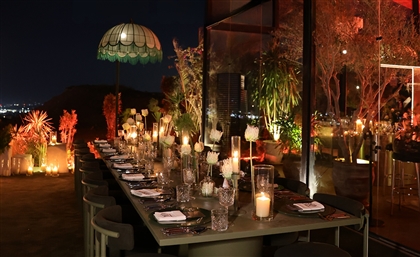
For the private opening, that story returned quite literally to the table. The Table by FR Studio designed an experience that translated the Sea, Desert, River, Mountain and Cairo into distinct materials, forms and tablescapes, furnished by Mosha Rentals. Flower Power’s botanical installations extended each landscape into a living sensory layer, while culinary partner The Cookery Co. transformed the exhibition’s narrative into a series of bite-sized canapés. The journey that had moved from land to kitchen to page was briefly reversed: visitors travelled from the page back through the landscape and finally towards something they could eat.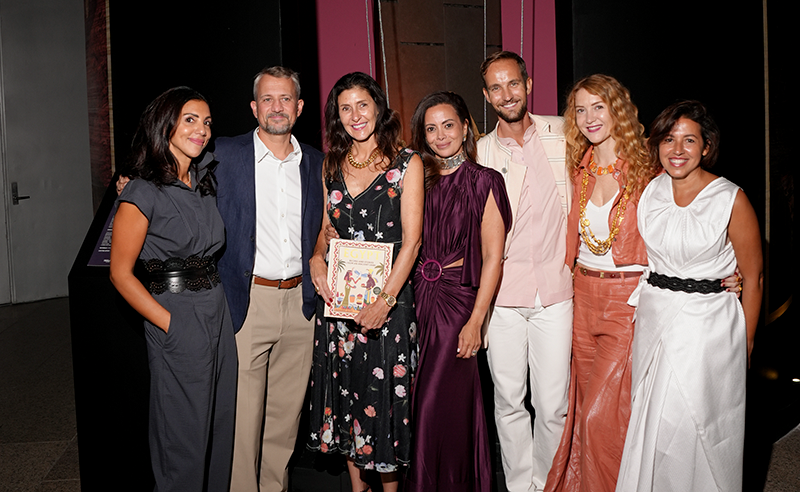 As part of Pepsi’s partnership across Cairo Food Week, Chipsy incorporated its Seed to Smile agricultural initiative into the River tablescape. The installation followed the potato from locally cultivated seed to finished product, drawing attention to the farmers and agricultural knowledge behind an ingredient often encountered only after its origins have been made invisible.
The private viewing also marked the regional celebration of Zeidy and Badrawi’s book, which launched on September 8th, with Diwan serving as the exhibition’s official bookseller. It was a homecoming in the most literal sense - years of travelling, listening, testing, photographing and writing had returned to Egypt, then taken up residence inside one of its museums.
The mountain gardens, fishing communities, desert hosts, Nile Valley breadmakers and guarded Cairene recipes were no longer contained between covers. They had acquired structure, light and scale through lighting artist Ghada Dwaik and lighting partner Lumino; material form through Khattab Invitations & Printing Solutions; and new interpretations through Makram-Ebeid, Shash, Mahdy, Eldib, James, Barthélemy and Fahmy. GT Events produced the exhibition, bringing its artistic, culinary and spatial elements together.
For Cairo Food Week, the experience offered a more expansive definition of what a food festival might contain. Dinner was present, but it was not the whole proposition. Food became a route into environmental change, women’s labour, migration, faith, agricultural knowledge, collective memory and the private acts of trust through which recipes enter the public record.
For Zeidy and Badrawi, it was the world of their book returned in another form. Publishers had once mistaken their own failure to recognise Egyptian cuisine for evidence that there was nothing to recognise. The authors answered first with a book too large for its commission and then, through ‘Tables of Egypt’, with a country too large for the book.
“We could have written five volumes,” Badrawi once said. “You can never stop writing about Egypt,” Zeidy added. “It’s endless.”
At the Grand Egyptian Museum, that no longer sounded like an author defending an overgrown manuscript. It sounded like the exhibition brief.
‘Tables of Egypt’ opened with a private viewing on September 25th and is open to the public at the Grand Egyptian Museum on September 26th and 27th.