

The Egyptian Cookbook Publishers Said the World Did Not Need
Suzanne Zeidy and Rawah Badrawi crossed the country to document the recipes, landscapes and lives that the publishing industry had failed to see.

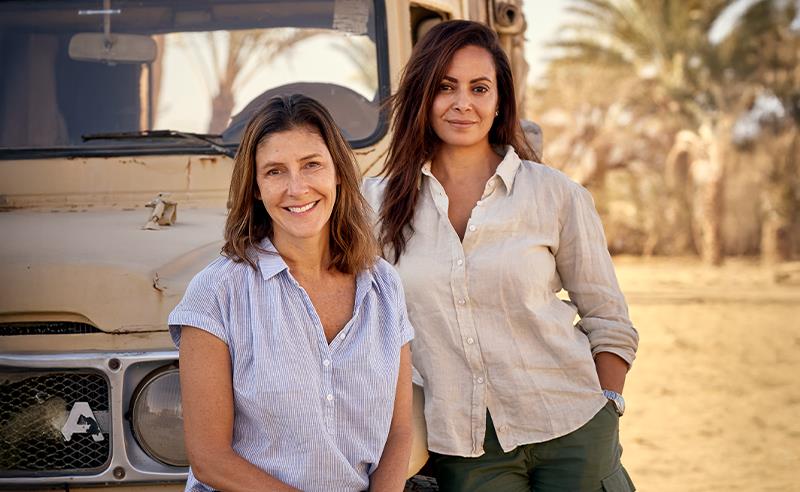
For the purposes of international publishing, Egyptian food did not exist. Global publishers told writers, anthropologists and archivists Suzanne Zeidy and Rawah Badrawi that Egypt could not sustain a cookbook because readers did not recognise it as a culinary destination. “People would say, ‘Egypt isn’t known for its food.’ Full stop,” Badrawi recalled.
Badrawi and Zeidy heard versions of this from publishers who otherwise took them seriously. The problem, as it was explained to them, was risk. They were neither celebrity chefs nor fixtures of food television. Zeidy had written Cairo Kitchen, then the rare contemporary cookbook of its kind, and Badrawi had published Siwa, a photographic memoir of the Western Desert oasis. Each had already made a book about Egypt. It was still insufficient proof that readers might want this one.
“Here we are, trying to convince people to publish Egypt,” Badrawi said. Their photographer, Jonathan Gregson, reduced the industry logic to a joke: “If you were writing an air-fryer cookbook, you’d get a publisher.”
The finished rebuttal weighs in at 420 pages.
Egypt: Recipes and Stories From an Ancient Land, to be published by Nourish on September 8th 2026, contains more than 150 recipes drawn from across 14 Egyptian cities and towns. It was commissioned at 300 pages. Zeidy and Badrawi submitted 120 more, after discarding photographs, histories and recipes. Badrawi estimates that another 200 recipes could have gone in.-75ff3f16-4812-4d33-aa58-b1daefad6d8f.png) “Imagine them saying that to you,” she said, “and then you run out of pages because you still have another 200 recipes you could have included.”
“Imagine them saying that to you,” she said, “and then you run out of pages because you still have another 200 recipes you could have included.”
The contradiction is satisfying, but it is also revealing. Egypt had not failed to produce a cuisine commodifiable enough for the international publishing industry. The industry had failed to build a category large enough to recognise it. Greece and Italy had been rendered through lavish culinary volumes; Lebanon, too, had been extensively documented. “A lot of our regional peers are very well-published and very well-covered in high-quality books,” Badrawi said. “But there is no magnum opus, there is no Egypt in a way that is different to the rest.”
What publishers call market awareness is partly inherited editorial memory; readers recognise what they have repeatedly been shown. A cuisine becomes internationally legible through accumulated books, restaurant coverage, television, travel writing and the authority of familiar chefs. The absence of that machinery can then be used against the people trying to create it.
-fc8c8082-bd61-44a6-8c71-38d7280fa426.png) Badrawi and Zeidy understood that securing a publisher was therefore part of the book’s argument. During what Badrawi calls “the darkest of times,” when one rejection followed another, the friends made a pact.
Badrawi and Zeidy understood that securing a publisher was therefore part of the book’s argument. During what Badrawi calls “the darkest of times,” when one rejection followed another, the friends made a pact.
“Let’s agree that we’re sitting on something incredible,” Badrawi told Zeidy, “and that we’re going to be patient while finding a publisher. What we don’t want to do is self-publish.” To do so, she felt, risked allowing the industry to preserve its own verdict: “Because somehow, if you self-publish, you’re almost making the statement that nobody wanted to do this.”
Their eventual publisher gave them creative control, trusting that the women who had done the research knew Egypt best. The result is a cookbook that behaves like a counter-archive. Its recipes matter, but its deeper subject is the system of knowledge around them: who cooks a dish, on what land, with which crop, after what migration, under what economic pressure, and by whose memory it has survived.
“The dish is nothing without context,” Zeidy said. “Who are the people? What is the land like?”
That question changed the shape of the project. Three years earlier, the book had begun as two smaller ideas exchanged between old friends. Badrawi was considering a book about Nubia; Zeidy was thinking about the food of Egypt’s coasts. As they compared notes, the boundary between the projects began to look artificial. They decided to combine them, then to expand again. Soon they were confronting the considerably less modest proposition of the entire country.
-1e3c011b-da13-44fb-ae4e-288861236763.png) The form took longer to find. Early drafts leaned heavily on history and risked reading like academic surveys. The authors compressed that material and expanded the travel narrative, allowing readers to enter each place with them before arriving at its recipes. The chapters became a melting pot of history, anthropology, and travel stories. “Once you get to the recipes,” Badrawi said, “it’s just a way to take everything into the kitchen and onto your dining table.”
The form took longer to find. Early drafts leaned heavily on history and risked reading like academic surveys. The authors compressed that material and expanded the travel narrative, allowing readers to enter each place with them before arriving at its recipes. The chapters became a melting pot of history, anthropology, and travel stories. “Once you get to the recipes,” Badrawi said, “it’s just a way to take everything into the kitchen and onto your dining table.”
The road supplied the research method.
“We went on the road to actually find recipes from remote places, from remote people,” Badrawi said, “not just search the internet or look in previous cookbooks.” Many of the dishes had never been recorded. “These are generational, they have never been documented, they have never been written down.”
When Zeidy entered a kitchen, she was often presented with movement rather than measurements. A cook demonstrated what her hands already knew. Zeidy filmed the process, returned home, wrote it down and tested it repeatedly until instinct had been translated into instructions another cook could follow.
“None of these recipes are written,” she said. “No one gives me anything written. They have to demonstrate it. I go home. I write it down. I test it. I'll do it again until it’s a recipe that you can follow.”
This translation could easily have produced a false definitiveness: the Egyptian recipe for a given dish, tidied for publication and severed from the woman who made it. The authors resisted that authority. “We’re saying this is her recipe,” Zeidy said. “This is her background. This is where she got it from. It’s her recipe. It’s not the recipe for XYZ.”
The distinction is the book’s ethical centre. Culinary canons tend to flatten variation so that a national cuisine becomes exportable and easily named. Egypt restores specificity. Recipes are credited to people and located in landscapes. Their differences are evidence, not errors to be resolved. The book’s claim to authority rests on refusing to pretend that one version can stand for everybody.
It also records the physical and social arrangements that make a recipe possible. In Minya, Zeidy, Badrawi and Gregson arrived at six or seven in the morning to watch four women make bataw, a local bread. The work lasted four or five hours. Each woman held a task in a process that could not be meaningfully understood as a solitary list of ingredients.
The women’s lives were hard; poverty in the Nile Valley was visible around them. The woman leading the tutorial was stern, keeping the group and its labour moving. At the end, she broke down.
“There is a sense of camaraderie among the women, essential to getting through the week or even the day,” Zeidy said. “They come together; the womanhood, the sisterhood, is essential.” In many households, she observed, the woman was also the principal earner, hustling to bring money home while carrying several other roles.
-fa4cd4ef-dd6d-4d49-946c-e8d8a047cbe4.png) For hours, the visitors watched, talked and worked beside the breadmakers while Gregson photographed them. “After those four hours, we were friends,” Zeidy said. “At the end, they were cheering and hugging us, so happy to share what they do, but also simply to connect. They don’t get that very often. It was really touching.”
For hours, the visitors watched, talked and worked beside the breadmakers while Gregson photographed them. “After those four hours, we were friends,” Zeidy said. “At the end, they were cheering and hugging us, so happy to share what they do, but also simply to connect. They don’t get that very often. It was really touching.”
The scene gives the lie to the neutral language of “collecting” recipes. Recipes do not sit inertly, waiting to be retrieved. Someone must decide to disclose one. Someone must give her time, demonstrate her technique and allow a private inheritance to become public. In return, the authors assumed responsibilities extending past transcription - to name the source, preserve the setting and refuse to reduce difficulty to picturesque rural life.
The relationships continued after the reporting trips. Zainab, a young Bedouin woman in St Catherine’s, still messages Zeidy every week or so to ask how she is and share news. In Marsa Matruh, the authors call Raheel when they want lamb sent to Cairo. When they visit, they leave with figs and olives pressed on them by their hosts. “We have friends all over the country now,” Badrawi said.
That intimacy gives substance to the book’s account of loss. Badrawi described oral culinary knowledge as a chain, “It’s a mother telling her daughter who tells her daughter, but now we have a disappearing culinary heritage.” In several regions, the ecological and economic conditions that produced the dishes are being altered beneath them.
St Catherine’s offered the most painful example. The Bedouin mountain diet was sustained by ancient gardens and a close knowledge of herbs, nuts, seeds, fruits, dates and goat products. Wild roses were dried for tea. One Bedouin woman gave the authors a box of rose petals; Zeidy carried it to Berlin and later to London, where the petals were photographed for a recipe. Open the box, she recalled, and the scent escaped.
But the work of bringing food down from the mountains has become harder, while co-operatives and supermarkets make pasta and bottled tomato sauce readily available. “We never used to go down and buy pasta,” the women told them. “We don’t buy pasta and put tomato sauce on it. That’s not our food.”
The replacement transfers dependency away from gardens, herding and inherited botanical knowledge, toward a standardised food supply designed for convenience and an expanding tourist economy. “When the government comes, opens a whole bunch of co-ops and supermarkets in your area and says, ‘Eat this food,’ while trying to turn it into a tourist destination, it’s very sad,” Zeidy said. “The mountain diet is a beautiful one, based on very ancient gardens.”-c391ba8f-6061-4d6f-9d09-45e7953ba9cb.png) On the North Coast, Badrawi saw development placing a similar pressure on Arab tribal communities. “They’re going to have to urbanise and work in the tourism and hospitality sectors to stay alive,” she said. “They’re not going to be able to graze their goats and sheep by the sea and run their fig and olive farms.” A cuisine cannot remain intact when its producers lose access to the land, work and rhythms that formed it. A recipe may preserve an instruction after the world that made it ordinary has disappeared.
On the North Coast, Badrawi saw development placing a similar pressure on Arab tribal communities. “They’re going to have to urbanise and work in the tourism and hospitality sectors to stay alive,” she said. “They’re not going to be able to graze their goats and sheep by the sea and run their fig and olive farms.” A cuisine cannot remain intact when its producers lose access to the land, work and rhythms that formed it. A recipe may preserve an instruction after the world that made it ordinary has disappeared.
The road also forced the authors to discard their own assumptions. Places expected to yield little opened up; promising destinations refused a neat story. Luxor, with its long history and constant traffic, proved difficult to describe through a single native culinary identity. Nearby Esna, however, held distinctive traditions and dishes whose names the authors did not recognise.
Cairo required a different viewpoint altogether. Badrawi came to understand the capital as “a melting pot of cultures and traditions and dishes that people brought with them.” Its culinary identity lay in accumulation. “It’s not a creator of a cuisine,” she said. “It’s a receiver of a cuisine.”
Instead of manufacturing a representative Cairene menu, the authors built the chapter from heirloom recipes belonging to established Cairo families of different ethnic backgrounds. Some had been guarded for hundreds of years. Persuading people to surrender them took patience, assurances and, at times, a bit of hard-earned pressure. After one great-aunt contributed a family recipe, a relative protested. “I can’t believe that my great-aunt gave you that recipe,” the person told Badrawi. “That’s unbelievable. She shouldn’t have given you that recipe.” Badrawi’s reply was pragmatic, “Well, too late.”
The humour does not diminish what was transferred. Private recipes can carry the history omitted by clean national narratives; Ottoman inheritance, Levantine movement, Greek and Italian communities, rural migration, class aspiration, marriage and exile. Cairo’s food emerges as a record of arrivals, kept in family kitchens long after the city has absorbed the people who brought it.
The book’s visual language makes the same argument about place. Gregson, an award-winning food and travel photographer who had worked with Zeidy on Cairo Kitchen, originally expected to photograph much of that earlier book’s food in London. During a preliminary trip to Cairo, he enlarged an image until a droplet of water revealed palm trees reflected inside it. “You do not get this in London,” he told Zeidy. “The light is different. Everything’s different.”
For Egypt, removing the dishes from the country was never seriously possible. Yet photographing Egypt carried another risk, reproducing the familiar visual shorthand of monuments, dust, colour and timelessness. “Egypt is both photographable and very not photographable,” Zeidy said. The challenge was to find somebody who could “extricate that visual within a whole load of mess around it.” Gregson’s pictures leave that landscape intact. “He doesn’t romanticise Egypt,” Zeidy said, “but by being honest in his work, you immediately see the beauty in it.”
Louis Barthélemy’s illustrations introduce a different layer. The French multidisciplinary artist, based in Cairo, created mythological and whimsical interpretations of Egypt for the cover and map. The combination gives the volume the presence of a photography book and the navigational pleasure of a travel narrative, while its price - GBP 30 - was kept deliberately below that of a luxury art object. “It isn’t a luxury book,” the authors insisted, even if it looks like one.
The intended correction also reaches Egyptian readers who may know a dish intimately while knowing little about where it travelled from or whose labour kept it alive. Each recipe is preceded by a small account of its possible origins, movement and context. “It’s lovely for Egyptians,” Zeidy said, “to finally become acquainted with the fascinating histories of their own foods.”
There is a danger in describing any book as rescue. The archive can preserve a recipe but cannot preserve access to a mountain garden. Publication cannot reverse Nubian displacement after the Aswan High Dam or protect Matruh’s grazing lands from development. Nor can two authors contain the culinary history of a country whose past extends across millennia and whose present keeps changing. Badrawi found compressing some regional histories almost impossible. Port Said could be entered through the 19th century; Luxor demanded a negotiation with pharaonic time. Five pages of history might have been accurate and still lost the reader.
The book’s achievement lies partly in making its incompleteness visible. It resists solving Egypt into a canon and shows why no single volume could. The 120 pages beyond the commission and the 200 recipes outside the binding become evidence of how much the premise “Egypt isn’t known for its food” had concealed.-4d3298ab-585b-4c52-ad0d-495802e26eee.png) The publication may also change the conditions for the next book. Badrawi recently received a voice note from an Egyptian food blogger in the United States who was writing her own proposal. She thanked the pair for doing “the heavy lifting.” After Egypt, she believed publishers would be ready. Readers would begin asking, “Give me more, give me more Egypt, give me more Egypt.”
The publication may also change the conditions for the next book. Badrawi recently received a voice note from an Egyptian food blogger in the United States who was writing her own proposal. She thanked the pair for doing “the heavy lifting.” After Egypt, she believed publishers would be ready. Readers would begin asking, “Give me more, give me more Egypt, give me more Egypt.”
The final answer to the publishers is larger than the existence of Egyptian food. The industry’s narrow picture of it excluded the very qualities that make it consequential; variation, movement, inherited knowledge, land, loss, humour and the stubborn generosity of people who shared what they knew. In Minya, four women make one bread because making it requires all four. In St Catherine’s, a box of dried roses carries the scent of a mountain garden across countries. In Cairo, a great-aunt releases a family secret before the family can stop her. These stories feed the recipes, just as history feeds the people who cook them.
And then, in hindsight, they feed us.
“We could have written five volumes,” Badrawi said. Their publisher eventually had to tell them: “Stop, stop. Stop writing this book now.”
Zeidy understood the problem differently.
“You can never stop writing about Egypt,” she said. “It’s endless.”
Egypt: Recipes and Stories from an Ancient Land will be released September 8, 2026 by Nourish Books in the UK and distributed worldwide by Penguin Random House.
It is available for pre-order by all major retailers including Diwan Bookstore for readers in Egypt.
Related Articles
Trending This Month
-

-
 Sep 12, 2026
 -

-