

Egyptian Food Lore With Food Historian Dr. Mennat-Allah El Dorry
Mennat-Allah El Dorry is an archaeobotanist specialised in Egyptian food and agricultural history. She speaks to us about the ancient histories of molokhia, kawareh, cheese, and fava beans.
The story of Egyptian food begins long before the modern kitchen.
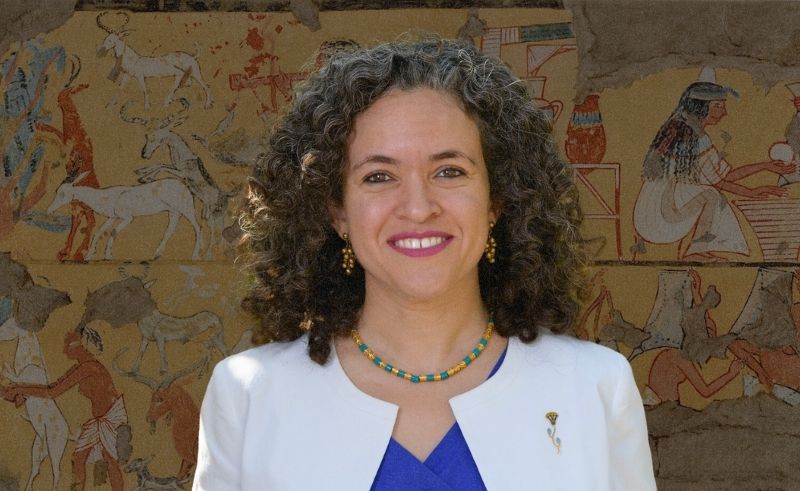
For Mennat-Allah El Dorry, an archaeobotanist specialising in Egyptian food and agricultural history, understanding what Egyptians eat today means studying what they grew, traded and consumed centuries ago. An assistant professor at the American University in Cairo and a lecturer at Ain Shams University, El Dorry has spent her career tracing those connections, following earlier work at the Egyptian Ministry of Antiquities that spanned nearly 15 years.
Speaking with SceneEats, she unpacks the histories behind some of Egypt’s best-known food staples and the stories they carry.
Molokhia
The savory, green superfood that we all love is the subject of many rumours. Common stories are that molokhia came from ancient Egypt, as a meal for kings tied to the word “malakia.” Another rumour is that the food was forced on Egyptians by the Hyksos, who mistakenly thought the food was poisonous. Despite this widespread oral tradition, there is no evidence — archaeological, historical, or otherwise — to substantiate these stories.
So what do we know about molokhia? The food’s first verified mention is when it was outlawed.
This story dates back to the Fatimid Period, under the rule of Caliph Al-Hakim ibn Amir il-Leh. “He banned everyone from eating molokhia. He also banned people from eating other foods,” El Dorry says.
Historians have not been able to confirm why he placed the ban, but El Dorry has a few suspected reasons. “One is that his predecessor was Sunni and loved molokhia, while he was Shiite. So he may have decided, let’s cancel this food. It could also be personal preference, that he simply didn’t like molokhia. We’re not entirely sure,” she says.
Regardless of the reason, the prohibition has a clear implication to El Dorry: “This ban indicates that, by the 11th century AD, molokhia was incredibly widespread and an important staple. That is certain.”
The word for molokhia likely comes from malachai, a Greek word meaning mallow that appeared as early as the first century AD in Egypt. “We don’t know if it means molokhia or if it’s referring to another type of mallow from the same family,” El Dorry says.
The superfood not only bounced back after being banned, but centuries later, it is now thriving as a cherished national comfort dish.
Kawareh
The people who built the pyramids might have been eating kawareh. And the historical remains that proved this were almost dismissed.
Pyramid builders lived in a settlement near the pyramids that has been under ongoing excavation for decades by the Ancient Egypt Research Associates Project. When archaeologists came across the end limbs or extremities of cows a few years ago, they thought these must have been used for rituals. But Egyptian students training in archaeozoology under the Project’s field school quickly connected the dots.
“They knew immediately that this is not a ritual, but most likely remains of kawareh — beef trotters full of bone and collagenous material. It’s a very nutritious and cheap cut of meat because it’s not actually meat, but collagen and cartilage,” says El Dorry. “Kawareh seems to have been part of the diet of Pyramid builders.”
The students were the ones to recognize this because they were familiar with Egypt’s culinary culture. El Dorry says, “They’re the ones who can observe things that Westerners who are not familiar with our cuisine may not observe or understand. It shows you don’t need to be a specialist to be able to understand and interpret items within our culture.”
Cheese
Srt. This is the ancient Egyptian word believed to indicate cheese, transliterated from hieroglyphs as S-R-T. In excavated tombs, researchers found srt from the north and srt from the south, and the word likely referred to various types of cheeses, hard and soft.
In a Ramesside tomb in Saqqara, dating about 3,200 years, a large pot housing a dried, hardened material was found. “When they analyzed it, they found out it was probably a type of cheese mixed from ovine and bovine milk. So, something like cow milk mixed with maybe sheep or goat milk. You can’t really distinguish between them,” says El Dorry.
This sample impresses her for several reasons. “It seems to have been a hard cheese based on the amount of fat in it. It may be one of the oldest, if not the absolute oldest, surviving sample of hard cheese in the world,” she says.
El Dorry explains that the chemical analysis we have today allows us to understand the remains of food from tombs better than ever before. “I’d love to get my hands on that sample,” she says of an older dairy product thought to be soft cheese found in a women’s tomb in Saqqara, dating back to the early dynastic period (around 5,200 years ago).
Along with the cheeses discovered in tombs, the word for halloumi cheese, beloved around the Middle East, may also have ancient origins. Evidence shows that around the 3rd or 4th century AD, the Coptic word ‘haloum’ was used to refer to a soft white cheese.
“That word might even have earlier roots in ancient Egypt. I don’t work so much with ancient Egyptian texts, so I can’t be 100% sure of that, but it seems to have earlier origins,” El Dorry says.
The halloumi that we know and love today, the squeaky cheese best for grilling, is most likely different from the ‘haloum’ referred to by Copts at the time, but we know for sure that the word is Egyptian.
“The word was used up until the medieval period to refer to a very specific type of cheese in Egypt. We actually have recipes to flavour haloum, the Egyptian cheese from the 14th century AD. Maybe the word travelled,” El Dorry says.
Fava Beans
For much of her career, El Dorry took for granted that fava beans were a staple of ancient Egyptian cuisine. Then one day, she started to question it.
“I’ve read so much literature about how ancient Egyptians ate fava beans and I took it at face value. Suddenly I had this realization that I’ve been working for almost 10 years on archaeobotanical remains in Egypt and I’ve never actually seen the remains of fava beans.”
The realization struck when El Dorry was working on a Coptic site from the early medieval period. “I thought, this is the first time I’ve ever seen fava beans. I’ve never seen them on other archaeological sites. I find important staples like lentils, wheat, and barely all the time, but never fava beans. What’s up with that?”
She started looking at all the reports ever published on archaeo-botanical material from Egypt. “I’ve gone through nearly every single report published in Egypt, and I found such little remains of fava beans documented from ancient Egyptian sites.”
She ultimately traced a trail of references in published papers citing fava beans all the way back to the source. The original publication, written by the archaeobotanist and archaeologist that originally excavated the remains, gave El Dorry her answer: the paper cited a type of wild Vicia — an uncultivated cousin of fava beans, Vicia faba.
“I did the same thing with every single incident of fava beans ever documented in ancient Egypt. Every single one of them has a problem with it. Either it’s a modern contamination, or a series of whispers gone through literature and until it became fact,” El Dorry says, “but these are not correct. It seems there were no fava beans in ancient Egypt.”
Around the first century AD in the Greco-Roman period, something happened that made Egyptians start eating fava beans. “Suddenly we started seeing fava beans everywhere on archaeological sites, in large amounts, in the Roman period and in Islamic sites.”
The sudden appearance of the beans is yet another mystery lost to time.
“Everything is a mystery. At the end of the day you’re going to ask me, ‘Menna, what do we actually know?’ and I’ll tell you, ‘we don’t know anything,’” El Dorry says.