

An App Set Me up for a Dinner With Four Strangers. Here's How it Went.
How else does one meet new people in a new city in the in the age of social media?


I recently moved back to Cairo after being away from the city for my entire adult life. I’ve sorted out the necessary things I need to sustain a life here, the things we find at the bottom of Maslow’s triangle. But in the interest of thriving, not just surviving, I’ve decided go out into the wild and try and meet friends. My first attempt was through a social platform app that sets you up for a dinner with random strangers.
There I was, sitting in the outdoor area of a mostly-empty Turkish-Lebanese fusion restaurant at an entirely empty table of five on a Wednesday night. My eyes fixated on the entrance as I watched people stroll past.
It was a typically breezy February evening in suburban Cairo, just after 8 pm. I was waiting for a group of strangers to trickle in and join me. People I’d never met before, people I knew nothing about, except for their fields of work and that they all willingly signed up for the same experience I had. Dinner with strangers.
About a week before that evening, I skimmed past a convincingly-written advertisement on Instagram that highlighted a social experience posed as an app. “Turn strangers into friends,” the copy read. “Meet new friends in your city.”
As someone living in a city I haven’t lived in as an adult, I was convinced. I’ve been looking to meet new people in Cairo. I wanted to make new friends, broaden my horizons, experience different things. As a man in my 30s, these things have become increasingly more difficult to do. Or at least, that’s the case for me.
So when a perfectly presented opportunity was handed to me by the magic of computed mathematics, I knew I couldn’t pass it up. I clicked on the link and landed on an app called Timeleft — a social platform which algorithmically allocates you to a group of strangers based on a list of personality-based questions and sets you off on an adventure where you are matched with said group at a restaurant for dinner.-3d040e98-a41b-449a-9258-d4067994f067.jpg) The majority of the experience remains a mystery leading up to d-day. Bit by bit, snippets of information are revealed; 48 hours prior to the dinner, details about the diners, including the industries they work in and their cultural background. The questionnaire asks you for your birthday, so I assumed we’d be paired with people around the same age. You find out the restaurant a day before your adventure begins.
The majority of the experience remains a mystery leading up to d-day. Bit by bit, snippets of information are revealed; 48 hours prior to the dinner, details about the diners, including the industries they work in and their cultural background. The questionnaire asks you for your birthday, so I assumed we’d be paired with people around the same age. You find out the restaurant a day before your adventure begins.
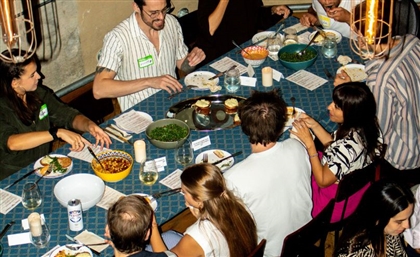
At around 9 pm on Tuesday, I knew I was going to have dinner at Opal with four people, all Egyptians, working in sectors including the arts, tech, services, and one was listed as ‘other.’ How curious.-01721127-b419-49d0-9efd-4ef1b4a7bf90.jpg) Back at the restaurant, I sat one seat to the right of the middle chair, a strategic move in my mind. I had read an article once that broke down the social psychology of where one should sit at a dinner table. Don’t sit immediately in the centre because you’ll attract all the attention.
Back at the restaurant, I sat one seat to the right of the middle chair, a strategic move in my mind. I had read an article once that broke down the social psychology of where one should sit at a dinner table. Don’t sit immediately in the centre because you’ll attract all the attention.
Sit at the head of the table and you’ll appear too authoritative and intimidating. The seat I chose also had the easiest exit route. I’m not sure what qualified the author to write an article about this subject, but I followed their direction regardless. I wanted no association with the stereotypes that may or may not be true.
One by one, individuals walked by. I studied them carefully, analysing their body language, trying to piece together what they said to the host at the restaurant. As each person walked in, I wondered if they were the aforementioned strangers that would be the company of the night.
About 45 minutes after we were supposed to meet, a man walked confidently up to the table. “Timeleft?” He asked me. “No, Omar.” I joked back. He didn’t laugh. My joke didn’t land. My worries that the tone of the evening was set started to surface. I blamed my inability to express myself properly in the Arabic language for the blunder. My Arabic isn’t bad. I just can’t express myself properly in the language — or land jokes sarcastically, apparently. I convinced myself to brush off the incident and that I had two more chances to make a better first impression. With the bar set so low, there’s no way I’d get it wrong again.
The second guest arrived ten minutes later, apologising before even sitting down. Not to me specifically, but for the general situation. We exchanged names, professions, and a brief acknowledgement of the app, as if it were a mutual acquaintance who had insisted we meet and then declined to attend. All in English, all to my relief.
By the time third and fourth guests arrived, the greetings were rehearsed. It all followed the same structure, and the exchanges of pleasantries were largely the same. An apology, a complaint about traffic, and a comment about how lovely the weather was.
We didn’t leave an opportunity for things to get awkward and ordered food almost immediately. A mutual understanding that if the dialogue dragged on for too long, we had at least timestamped an end-point for the conversation.
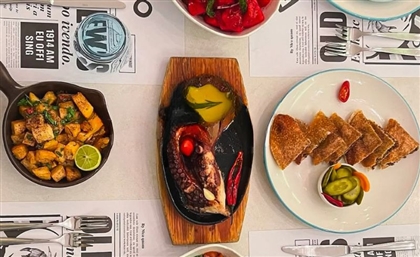
I ordered two starters for the table as a symbol of new friendships starting with breaking bread; a metaphorical extension of an olive branch if you will, except there were no arguments, and the olive branch was halloumi cheese filled samosas and an overfilled plate of spicy potatoes.-a728f828-efba-4674-adfa-bd052b8683d2.jpg) Conversation began soon after. Carefully, like we were all beta-testing each other. Safe topics surfaced first, work, the weather, how hard it is to meet new people as adults, which, considering the circumstances, felt like attending a seminar on swimming while already in the pool. The app had promised an ‘adventure,’ which in practice translated to sitting at a restaurant we did not choose, with people we did not know, discussing jobs we did not fully understand.
Conversation began soon after. Carefully, like we were all beta-testing each other. Safe topics surfaced first, work, the weather, how hard it is to meet new people as adults, which, considering the circumstances, felt like attending a seminar on swimming while already in the pool. The app had promised an ‘adventure,’ which in practice translated to sitting at a restaurant we did not choose, with people we did not know, discussing jobs we did not fully understand.
And yet, it worked. Not in a life-altering, group-chat-created-on-the-spot way, but in the subtle way most real social interactions work. Someone made a joke that landed. Someone else had strong opinions about where to find the best koshary. Some discovered mutual acquaintances and collectively decided not to unpack that too deeply.
The food arrived in the timeliest of manners. We’d pretended to laugh one too many times about the absurdity of certain work quirks and the difference in work habits between our generation and Gen Xers and Baby Boomers. It got stale. But the kafta, shish tawkwook, the spaghetti and the kebap become more than just food, they became another point of connection and a saving grace for a dying conversation that was starting to turn incredibly awkward.
The menu at Opal was diversely delicious. Dishes that, on the surface, made no sense being on the same page, were all tied together under one thematic umbrella. What we ordered made no sense as a collective. Individually, they all had unique origins. They were prepared differently, presented in a non-identical way, cooked with contrasting ingredients. It felt as though this was a metaphoric representation of the whole experience of having dinner with strangers. People, all with different experiences, presenting themselves differently, all coming together under a collective purpose with a mutual understanding.
We exchanged Instagram handles near the end of the night in the ceremonial way millennials do, with an unspoken understanding that these followers would likely eventually become background stories we watch and later forget how we knew the individuals behind them.
There was something inherently amusing about the entire premise. Five fully grown adults, all socially functional, all capable of initiating conversations in the wild, had collectively decided that the most efficient way to meet other humans was through a questionnaire that asked us whether we preferred sunsets or sunrises, art galleries or night clubs. As it turns out, the correct answer was apparently “Wednesday at 8 pm in Sheikh Zayed.”
The evening didn’t dramatically change my social life. I didn’t leave with a new best friend or a five-year plan. What I left with was the realisation that making friends in your thirties in a new city isn’t impossible, it just now comes with personality quizzes, awkward jokes, and the comforting knowledge that if all else fails, there’s probably an app for a second attempt.
- Previous Article All the Valentine’s Desserts Worth Falling For
- Next Article Mediterranean Restaurant Almería is a Living Archive in Cinema Radio