

Kocha Is a 4-Square-Meter Kiosk Serving Koshari in Paris
A dish like Koshari does not win by appearance, it wins by conquering, dividing and eventually winning. That is how Chinese noodles did it.

Originally published on January 17th, 2026
Paris has counters for everything: falafel, bao, smash burgers, hummus, things on sourdough that do not need sourdough.
And koshari too. What it lacks is volume; a dish like Koshari does not win by appearance, it wins by conquering, dividing and eventually winning. That is how Chinese noodles did it.
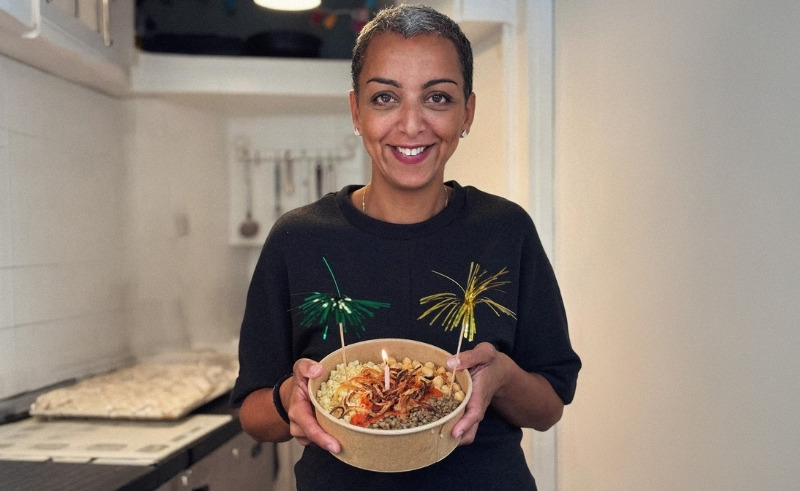
Christine Taieb, of Egyptian origin, was born in Paris to restaurateur parents from Assyut. She grew up between cultures and inside kitchens until she noticed koshari’s marginalisation on a quiet Sunday. “My mother made koshari and my husband absolutely loved it,” she says. He looked at the plate and asked the question: “How is it possible that no one has done this here enough. And that I’d never even heard of it.” At first, the idea stayed close to the confinement home, a dish she wanted to cook for him more often but rarely did since koshari takes time. “I never cook it at home because it takes so long to prepare,” she admits. But the way koshari existed in Paris felt unserious. “Even though it’s one of the most iconic and beloved dishes in Egypt,” she says, “it never really had its space here.”
As of 2025, koshari officially joined UNESCO’s Representative List of the Intangible Cultural Heritage of Humanity, the first everyday Egyptian street dish to earn that recognition. Egypt’s national carb-and-onion masterpiece now sits in the same global heritage category as couscous and ceviche, a formality that feels long overdue for a dish this widely eaten and rarely celebrated.
Taieb conceived KOCHA out of a clear desire to see koshari take up more space, the way biryani or hummus did before it. She doesn't plan to translate the dish and never intends to. “It was about wanting to introduce a true Egyptian street food dish, without altering it,” she says, “and sharing a piece of my family history.” When people unfamiliar with Egyptian food ask what koshari is, “I often say it’s Egypt’s ultimate comfort food,” she tells SceneEats. A mix of starches and legumes, spiced tomato sauce, crispy fried onions. “A simple, generous dish that genuinely surprises people the first time they taste it.”
“I wanted to keep the spirit of Cairo,” Taeib explains, “a counter, one dish, total efficiency.” At the same time, Paris demands care in execution. “KOCHA is where authentic street food meets the modern aesthetic of Parisian concepts.”
The constraints were physical as much as conceptual. “On just four square meters, I had no choice but to focus on a single dish,” she says. “That’s how the idea of a signature plate was born.”
Early reactions followed a familiar rhythm. People looked. They hesitated. Then they tried it. “People asked, ‘What is koshari?’” she recalls. The mix looked heavy, strange, a bit too much. Then they tasted it. “They all came back.”
Customers spoke about how indulgent the dish felt, how filling it was, and how unexpected it was that something this comforting was fully plant based. “Today, we have a loyal clientele,” she says, “who return for that taste from elsewhere, but also for the comforting quality you don’t necessarily expect from a foreign cuisine.”
There were parts of the recipe she would not touch. “The foundations are untouchable,” Taeib says. “Lentils, pasta, round rice, chickpeas, tomato sauce, and fried onions. That’s the DNA of the dish and there’s no compromising on it.”
“All the flavor of koshari comes from the homemade fried onions. Everyone thinks they’re just a garnish,” she says, “but in reality, they’re the heart of koshari.” They carry the crunch and depth. “Without them, the plate doesn’t have the same soul.” The garlic sauce has its place too, more sous-chef than star.
“The only adaptations are in the methods, not the ingredients,” she explains. “But the taste stays Egyptian, not Frenchified.”
Koshari has been vegan long before veganism learned how to explain itself, defend itself, or argue with you at every dinner. “I didn’t have to remove anything. I’m proud to offer a popular, authentic, plant-based dish without turning it into a marketing argument. It’s simply the truth of the dish.” Running an Egyptian concept abroad comes with pressure, especially from expat Egyptians who will never miss a chance to tell you how their mother does it. "I want to show koshari exactly as it is in Egypt,” she says. “My responsibility is to respect the dish, its history, and the people who love it there.”
Her own order never changes. “A hot koshari, a cold hibiscus juice, and a small rice pudding for dessert,” she says.
She thinks beyond a single counter; “I want to go far beyond that,” she says. “I want koshari to be a dish that’s known and recognized across France.” A day where the suggestion needs no explanation. “Shall we get koshari,” said as casually as pizza or a burger.
Kocha now operates out of a tiny counter on 34 rue coquillère 75001, best visited on days when onion breath will not ruin a date you do not have.
- Previous Article New Cairo is Getting Another Asian Food Truck This April
- Next Article Mediterranean Restaurant Almería is a Living Archive in Cinema Radio